
Industrial facilities depend on uninterrupted operations and real-time visibility. Even a small outage can affect productivity, safety, and operating costs. This is why many organizations now rely on integrated remote monitoring tools instead of disconnected monitoring systems.
Telecommunications networks, data centers, utilities, and renewable energy facilities generate large amounts of operational data every second. Without centralized monitoring, operators often struggle with delayed responses and limited visibility.
PLC Group helps organizations convert operational data into measurable business value. Its integrated monitoring ecosystem combines analytics, automation, and intelligent controls into one scalable platform. This approach supports predictive maintenance, energy optimization, and infrastructure reliability across mission-critical environments.
How Do Point Solutions Create Operational Challenges?
Point solutions usually focus on one task or one asset category. One system may monitor cooling equipment, while another tracks energy usage or alarms. This separation creates operational silos and slows response times.
When facilities use multiple disconnected systems, operators often face:
- Limited visibility across assets and locations
- Delayed fault identification and response
- Higher maintenance and integration costs
- Increased downtime risks
- Complicated reporting and analytics
These challenges become more serious in large-scale industrial environments. Separate dashboards and isolated alarms make root-cause analysis more difficult. Teams spend more time managing systems instead of improving performance.
What Makes Integrated Remote Monitoring Tools More Effective?
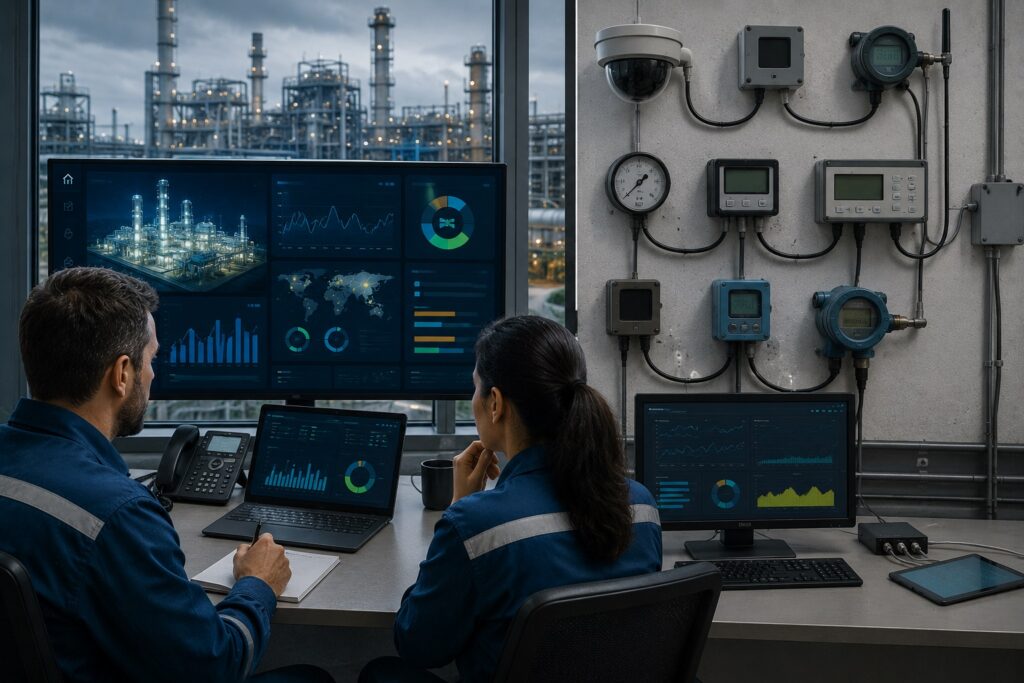
Integrated remote monitoring tools centralize monitoring, analytics, and automation into one environment. This allows operators to monitor infrastructure performance in real time while improving operational efficiency.
PLC Group combines intelligent software platforms with scalable remote monitoring hardware to support complete infrastructure visibility. Its solutions integrate HVAC systems, energy meters, cooling systems, sensors, and industrial controllers into one ecosystem.
This approach provides:
- Unified dashboards for faster decision-making
- AI-driven analytics for predictive maintenance
- Real-time alarms and automated responses
- Centralized monitoring across multiple facilities
- Improved energy and operational efficiency
Integrated platforms also support long-term scalability. Organizations can expand infrastructure without deploying separate monitoring systems for every new asset.
How Does PLC Remote Monitoring Improve Infrastructure Performance?
PLC remote monitoring solutions are designed for mission-critical infrastructure environments. The platform combines industrial IoT connectivity, AI-powered analytics, and actionable intelligence to improve uptime and asset performance.
Unlike traditional monitoring setups, PLC Group delivers visibility across entire operational ecosystems. Operators can monitor cooling performance, energy consumption, environmental conditions, and infrastructure health from one interface.
The platform also supports predictive maintenance. By identifying abnormal behavior early, organizations can prevent equipment failures before they disrupt operations.
PLC Group solutions support industries including:
- Telecommunications
- Data centers
- Utilities
- Renewable energy facilities
- Cable landing stations
- Public safety networks
Its scalable deployment model also helps organizations manage operational costs more effectively while improving infrastructure resilience.
Why Does Remote Monitoring Hardware Matter in Modern Facilities?
Software alone cannot provide accurate operational intelligence. Reliable remote monitoring hardware plays a critical role in collecting and transmitting real-time data from field equipment and infrastructure assets.
PLC Group integrates advanced sensors, controllers, gateways, and monitoring devices into its ecosystem. This hardware supports industrial protocols and enables seamless communication between assets and monitoring platforms.
Modern remote monitoring hardware improves:
- Data accuracy and reliability
- Real-time operational visibility
- Alarm response times
- Infrastructure automation
- Energy optimization strategies
This integrated design helps facilities reduce operational complexity while improving decision-making speed.
How Can Organizations Build Smarter Monitoring Strategies?
Industrial infrastructure continues to become more connected and data-driven. Organizations now require centralized visibility, predictive analytics, and scalable automation to remain competitive.
Integrated Remote Monitoring Tools provide stronger operational control than isolated point solutions. They simplify infrastructure management while improving uptime, energy efficiency, and asset life.
PLC Group helps organizations modernize critical infrastructure with intelligent monitoring, AI-powered analytics, and scalable industrial IoT solutions. Contact PLC Group to learn how integrated monitoring platforms can improve operational visibility and long-term infrastructure performance.