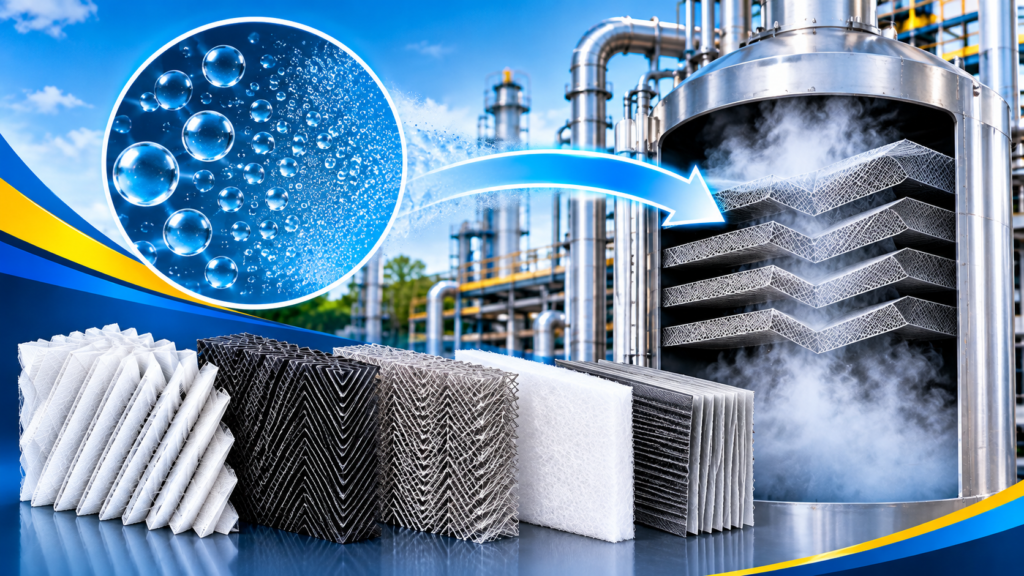

Most mist eliminator filter problems start with the wrong assumption about droplet size.
Two systems might run at the same gas flow rate and still need completely different media. A phosphate scrubber, for example, does not necessarily create the same droplet distribution as a sulfuric acid tower. One might produce coarse carryover. The other might generate sub-micron aerosol.
If the media is selected around 10-micron droplets while the process produces droplets below 1 micron, extra surface area or higher pressure drop will not fix the mismatch.
The first question should be simple. What droplet sizes are present?
People Also Ask
What does a mist eliminator filter do?
A mist eliminator filter removes liquid droplets from gas streams using impaction, interception, or diffusion, depending on droplet size and media design.
How does droplet size affect mist eliminator filter selection?
Droplet size determines the dominant capture mechanism. Larger droplets suit vane or mesh media, while sub-micron aerosols often require fiber bed technology.
What mist eliminator filter media works best for 2 to 5 micron droplets?
Structured or knitted mesh works well in the 2 to 5 micron range, where impaction and interception both contribute to droplet capture.
Why Droplet Size Governs Media Choice
Every mist eliminator filter relies on one or more physical capture mechanisms, mainly impaction, interception, and diffusion.
Each mechanism works best within a different droplet size range.
Media designed around 10-micron droplets might miss much of a sub-micron aerosol because the droplets behave differently in the gas stream. Flow rate and liquid loading still matter for equipment sizing. Mist eliminator droplet size determines which capture mechanism does the work.
That distinction matters more than the industry name on the process.
How Mist Forms and Why Formation Sets the Size Range
Droplet size starts with the way the mist forms.
Three formation mechanisms account for much of the mist found in industrial gas streams, and each one tends to produce a different size range.
Mechanical Entrainment and Spray Carryover
Spray nozzles, bubbling liquid, and splashing from trays or packing surfaces tend to produce larger droplets.
These droplets often range from about 10 microns to several hundred microns. Their higher momentum makes them easier to remove through inertial impaction.
This is the more forgiving end of mist separation.
Condensation and Flashing
When vapor cools and condenses, or when liquid flashes into vapor before recondensing farther downstream, much smaller droplets often form. Some fall into the sub-micron range.
Evaporators, absorbers, and processes with a meaningful temperature drop across the vessel often produce this type of mist.
Chemical Reaction Aerosols
Chemical reactions also produce fine aerosols.
Sulfuric acid absorption and ammonia neutralization are common examples. Instead of forming through mechanical breakup, droplets form through nucleation and often begin in the sub-micron range.
This is one reason sulfuric acid plants commonly use fiber bed technology rather than standard mesh.
The Three Main Capture Mechanisms
Mist eliminator filter media works by matching the media structure to how droplets move through the gas.
The dominant mechanism changes as droplet size decreases.
Inertial Impaction Above Roughly 3 Microns
Larger droplets have enough momentum to move away from the gas streamline when the flow bends around a fiber or vane.
They hit the media instead.
Impaction plays the largest role in vane separators and coarse mesh. Within the proper operating range, increasing velocity strengthens this effect because the droplets carry more momentum.
Direct Interception in the Intermediate Range
Droplets between roughly 1 and 3 microns follow gas streamlines more closely.
At this point, fiber size becomes more important. Finer fibers give droplets more opportunities to contact the media as they pass through the bed.
Interception becomes increasingly important as impaction starts losing effectiveness.
Brownian Diffusion Below 1 Micron
Sub-micron droplets behave differently again.
Molecular collisions push these fine droplets into irregular paths through the gas. This movement increases their chance of contacting fibers even though their low mass makes impaction ineffective.
Diffusion works better at lower velocities, the opposite of impaction.
A submicron mist eliminator depends heavily on this mechanism.
The 10 Micron and Above Range
Droplets above about 10 microns are comparatively straightforward to remove.
Mesh, vane, and fiber bed systems can all capture droplets in this range because momentum does much of the work.
Vane separators often make sense where droplets stay coarse and liquid loading is high. They handle large quantities of entrained liquid while keeping pressure drop relatively low.
Specifying fine media for a stream dominated by large droplets adds little value if a simpler separator already handles the duty.
The 2 to 5 Micron Range
This range fits mesh media well.
Knitted mesh and structured mesh both use a mix of impaction and interception to collect droplets. Structured Mist eliminator filter media often improves the balance between capture efficiency and pressure drop because more fiber surface sits in a useful orientation to the gas flow.
The difference becomes more important as droplet size moves toward the lower end of the range.
The 1 Micron Threshold
Around 1 micron, ordinary mesh starts reaching its practical limit.
High-performance structured mesh with finer fibers and a high void fraction reaches efficiencies above 99 percent at 1 micron under suitable operating conditions. Standard knitted mesh rarely performs at the same level.
Below this range, performance falls quickly.
Reviewing mist eliminator efficiency micron by micron makes the limitation easier to see. Media suited to 3- or 5-micron droplets does not automatically remain suitable once the distribution shifts below 1 micron.
Kimre’s B-GON® structured mesh is built to hold that 99 percent efficiency at 1 micron in service, not just on a datasheet, by keeping fiber orientation and void fraction consistent across the full pad.
Sub-Micron Aerosols and the Limits of Mesh
Sub-micron droplets follow gas streamlines closely enough to pass through mesh without reliably contacting the fibers.
Making the mesh finer does not solve the entire problem.
A submicron mist eliminator needs diffusion to become a major part of the capture process. Dense fiber bed candle filters provide the high surface area required for this type of separation.
Sulfuric acid production is a common example. Fiber bed systems used in fine acid mist service reach efficiencies up to 99.9 percent, with pressure drops ranging from about 2 to 20 inches of water column depending on the design.
This is where stretching mesh beyond its intended range becomes expensive without solving the underlying separation problem.
Kimre manufactures fiber bed candle filters as both new elements and re-packs, so a sub-micron application can move to diffusion-based media without replacing an entire vessel’s internals.
Fiber Diameter and Void Fraction
Selecting the general media type is only the first step.
Fiber diameter and void fraction still affect bed performance.
Smaller fibers improve interception and diffusion because droplets encounter more fiber surface. Pack the fibers too tightly, though, and pressure drop rises while fouling becomes more likely.
High-performance structured media spans fiber diameters from roughly 0.05 mm to nearly 1 mm, with void fractions around 94 to 97 percent.
These variables give engineers room to match the media more closely to droplet distribution, contaminant loading, and pressure-drop limits.
Composite Media for Wide Droplet Distributions
Industrial gas streams rarely contain one neat droplet size.
A single stream might carry coarse liquid along with much finer mist. Composite media handles this by placing a higher-capacity section upstream and a finer section downstream.
The first layer removes bulk liquid. The second handles the smaller droplets left behind.
This arrangement prevents one section from carrying the full separation duty.
Multi-Stage Separation for Wider Distributions
Some streams cover too broad a droplet range for one media bed.
Where coarse carryover and sub-micron aerosol appear together, a multi-stage system often makes more sense.
A vane separator or packed section might remove larger droplets first. A fine mist stage then handles the remaining aerosol farther downstream.
Each stage works within the range where its capture mechanism performs best.
Trying to force one separator to handle everything usually means accepting a compromise somewhere.
How to Characterize Your Droplet Distribution
Guessing costs more than measuring.
Process type gives engineers an initial clue. Mechanical entrainment tends to produce larger droplets, while reaction aerosols usually sit much lower in the size range.
A better approach is to characterize the actual distribution through droplet-sizing measurements or infer the likely range from known process conditions such as nozzle pressure, temperature change, and reaction chemistry.
For more detail on the relationship between droplet size, velocity, and liquid loading, see Kimre’s technical guide to mist elimination in industrial gas streams.
What Data to Supply for a Media Recommendation
Accurate mist eliminator filter selection starts with droplet size, though several other operating details still affect the final design.
Share the droplet size distribution, or the best available estimate.
Include the gas flow rate and normal operating range, along with liquid loading and the amount of liquid the media needs to drain.
Gas temperature, pressure, and chemical composition also matter.
Vessel dimensions and installation space also affect the available options.
Finish with the required removal efficiency and allowable pressure drop.
Kimre’s engineering team reviews these conditions before recommending standard or custom media. The goal is to match fiber diameter, void fraction, and media type to the actual process distribution rather than relying on a broad industry assumption.
Final Word
Droplet size should lead the media decision.
Coarse carryover above 10 microns often suits vane or mesh separation. Structured mesh performs well through much of the 2 to 5 micron range. Near 1 micron, media design becomes more critical. Below 1 micron, a fiber bed is a better fit for fine aerosol service.
Get the droplet distribution right first.
From there, mist eliminator filter selection becomes an engineering decision, not a guess.
Frequently Asked Questions
What is the best mist eliminator filter for droplets above 10 microns?
Vane separators and mesh media both perform well above 10 microns. Vane systems are especially useful where liquid loading is high and low pressure drop matters.
How does mist eliminator efficiency change by micron size?
Mist eliminator efficiency depends on both media type and droplet size. Mesh performs well on larger droplets, while efficiency drops as droplets move into the sub-micron range.
Why does mesh media struggle with sub-micron droplets?
Sub-micron droplets follow gas streamlines closely and carry too little momentum to impact effectively. Fiber beds use Brownian diffusion to improve capture at this size.
What affects mist eliminator filter media performance besides droplet size?
Gas velocity, liquid loading, fiber diameter, void fraction, chemical compatibility, pressure drop, and available vessel space all affect final media performance and system design.
Why is droplet size important before choosing mist eliminator filter media?
Without a reliable droplet-size estimate, engineers risk selecting media built around the wrong capture mechanism, leading to poor efficiency or unnecessary pressure drop.
