
Wind energy projects are expanding across Canada as provinces pursue renewable power targets and long-term energy transition goals. Alongside environmental benefits, wind developments must also address community impacts related to sound and vibration. When acoustic considerations are not managed properly, project approvals, operational timelines, and stakeholder relationships can be affected.
Wind turbine noise monitoring plays a critical role in maintaining regulatory compliance and protecting project viability. Through structured measurement and analysis, monitoring programs verify whether operational turbines meet established noise limits and environmental guidelines. For developers, regulators, and communities, monitoring provides objective data that supports transparent and defensible decision-making.
People Also Ask
1. Why is wind turbine noise monitoring required in Canada?
Monitoring verifies that operational turbines meet provincial noise limits and environmental approval conditions.
2. How is wind turbine noise measured during monitoring programs?
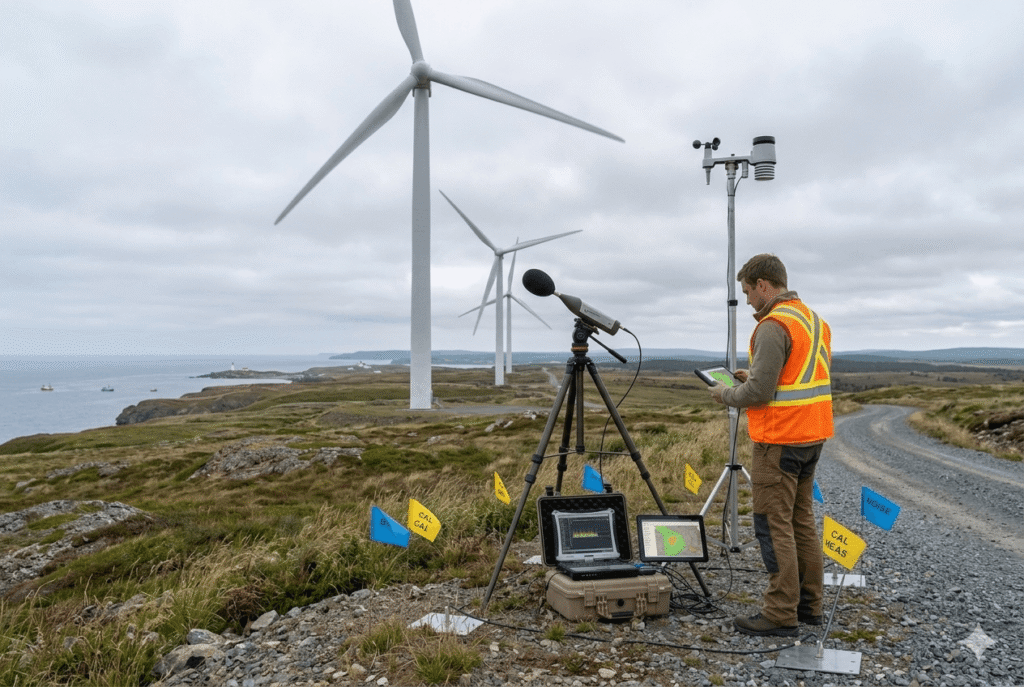
Acoustic consultants use calibrated sound level meters combined with meteorological data to perform accurate wind turbine noise measurements under controlled conditions.
Canada’s Regulatory Framework for Wind Turbine Noise
Canadian wind energy projects operate within a network of provincial regulations, municipal bylaws, and environmental assessment requirements. These frameworks establish permissible sound levels at nearby receptors and outline procedures for evaluating potential impacts.
A comprehensive wind turbine noise assessment is typically required during planning stages to predict operational noise levels. After turbines become operational, monitoring programs help confirm that measured sound levels align with approved thresholds and environmental commitments.
What Wind Turbine Noise Monitoring Involves
Wind turbine noise monitoring combines field instrumentation, environmental data collection, and acoustic analysis. Sound level meters and weather monitoring equipment are deployed near representative receptor locations to measure noise under varying wind and atmospheric conditions.
The resulting dataset forms the basis for the analysis of wind turbine noise measurements. Consultants evaluate turbine operational states, background sound levels, and meteorological factors to determine whether sound emissions remain within regulatory limits.
How Monitoring Protects Project Approvals and Investment
Regulatory approvals often rely on predictive modelling conducted during environmental assessments. Once turbines are operational, monitoring confirms that real-world performance matches those predictions.
Effective wind turbine noise monitoring provides documented evidence that project operations comply with approved limits. This verification helps protect long-term investment by reducing the likelihood of regulatory disputes, operational restrictions, or reputational challenges.
Common Compliance Risks Without Professional Monitoring
Projects that lack structured monitoring may face several compliance risks. Noise complaints from nearby communities can trigger regulatory investigations, requiring operators to demonstrate compliance with the conditions of approval.
Without credible measurement data, determining the source and magnitude of sound emissions becomes difficult. Independent wind turbine noise assessment conducted by qualified professionals ensures that monitoring results are technically defensible and aligned with regulatory expectations.
The Role of Consulting Engineers in Wind Turbine Noise Monitoring
Consulting engineers bring analytical rigor and independence to monitoring programs. Their role includes designing monitoring plans, selecting appropriate measurement locations, interpreting results, and preparing documentation for regulatory authorities.
Through engineering-led analysis, wind turbine noise measurement results are translated into actionable findings that guide operational decisions, mitigation strategies, and regulatory reporting.
Monitoring as a Strategic Compliance Safeguard
Wind energy development depends on maintaining trust with regulators, communities, and project stakeholders. Wind turbine noise monitoring provides the objective foundation required to demonstrate compliance and maintain operational certainty.
Valcoustics supports renewable energy projects through consulting-engineer-led acoustic monitoring, wind turbine noise assessment, and regulatory documentation. By combining field measurement with engineering analysis, Valcoustics helps ensure wind energy facilities operate within approved acoustic limits.
Contact Valcoustics to discuss monitoring requirements for wind energy projects.