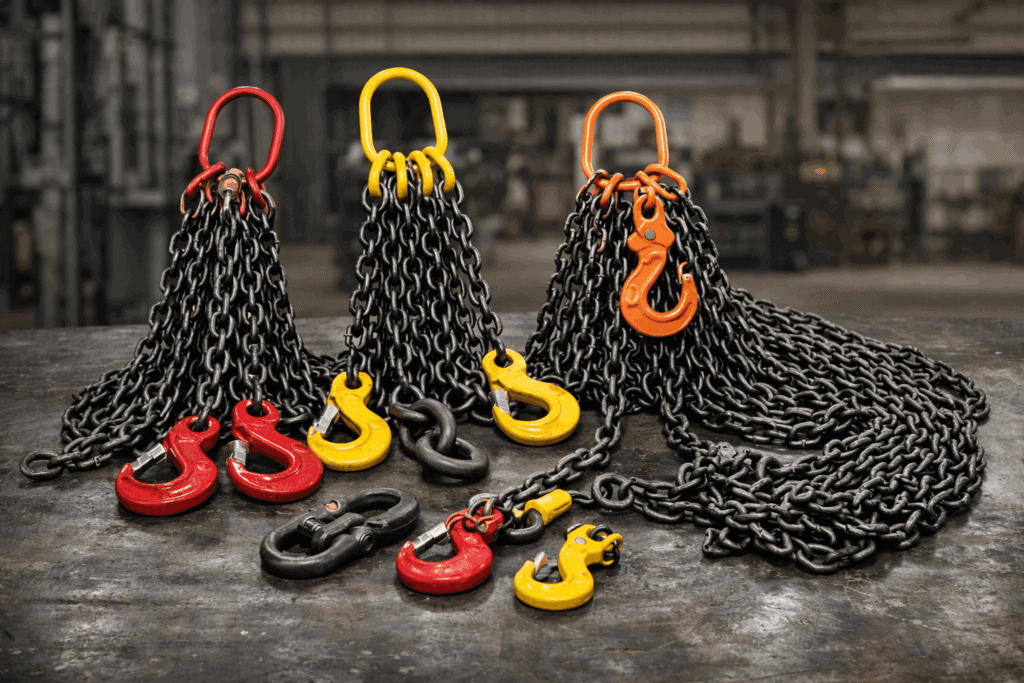

When handling heavy loads, strength is often the primary factor. However, capacity alone does not determine the safest or most efficient lifting setup. Configuration, connection points, adjustability, and application environment all influence performance. Choosing between lifting chains and chain slings requires understanding how each functions within a complete rigging system.
Murphy Industrial Products, Inc. supplies both raw chain and fully assembled sling systems for industrial lifting operations. Selecting the right solution depends on whether the job requires straight-line pulling strength or a configurable lifting assembly.
Lifting Chains – Raw Material, Grade, Straight Pull Use
Lifting chains are individual lengths of alloy steel chain designed for overhead lifting when manufactured to proper grade standards. Common industrial grades include 80, 100, and 120, each offering increasing working load limits.
Heavy-duty lifting chains are often used for:
- Straight vertical pulls
- Securing or stabilizing loads
- Fabrication or manufacturing support
- Custom rigging assemblies
Because they are supplied as raw chain lengths, they offer flexibility in fabrication and can be cut to required dimensions. Their strength and abrasion resistance make them suitable for harsh environments such as construction sites and steel plants.
However, the raw chain alone does not provide attachment hardware or multiple lifting points. Additional components must be added to create a functional lifting assembly.
Chain Slings – Leg Variations, Hook Options, Adjustability
In contrast, chain slings are complete lifting assemblies made from alloy chain legs connected to a master link and fitted with hooks, shortening clutches, or other hardware. They are available in single-leg, two-leg, three-leg, and four-leg configurations.
This design allows load distribution across multiple attachment points. Adjustability through shortening hooks or grab hooks helps accommodate uneven loads and variable lifting angles.
Chain slings are commonly used in:
- Structural steel erection
- Equipment installation
- Rigging of large fabricated components
- Tower and industrial plant lifting
Murphy Industrial Products, Inc. provides pre-assembled sling systems engineered to meet industrial load standards. These assemblies simplify setup and reduce the need for on-site fabrication.
Comparison of Durability, Flexibility, and Safety
Both lifting chains and chain slings are highly durable. Alloy steel construction resists abrasion, impact, and high temperatures better than many synthetic alternatives.
In terms of flexibility, chain slings provide greater adaptability. Multiple legs allow improved load balance, while a raw chain is typically limited to straight-line applications unless modified with additional hardware.
From a safety standpoint, factory-assembled slings reduce the risk of configuration errors. Raw chain setups require careful pairing with rated hooks and connectors to maintain compliance.
For complex heavy lifts, chain slings often provide better load control. For direct pulls or custom applications, lifting chains offer versatility in materials.
Maintenance and Inspection Differences
Inspection procedures apply to both options, but the scope differs.
For lifting chains, inspection focuses on:
- Link elongation
- Wear and deformation
- Cracks or corrosion
- Grade markings
For chain slings, inspection extends to:
- Master links
- Hook conditions and latches
- Sling leg balance
- Attachment hardware
Heavy-duty lifting chains used in custom setups require verification that all added components meet load requirements. Pre-assembled slings from Murphy Industrial Products, Inc. simplify documentation and inspection tracking.
Best Use Cases for Each
Lifting chains are best suited for:
- Straight vertical pulls
- Fabrication shops
- Custom rigging configurations
- Situations requiring cut-to-length chain
Chain slings are ideal for:
- Multi-point lifting
- Offset or uneven loads
- Rigging assemblies that require adjustability
- Repetitive heavy-lifting tasks
Selecting between these options depends on load geometry, lifting angle, and jobsite requirements.
Match Lifting Gear to Job Requirements
The choice between lifting chains and chain slings is not about strength alone. Both offer high-capacity performance when manufactured to proper grade standards. The key difference lies in configuration and application.
For straightforward pulls and custom fabrication, heavy-duty lifting chains may be sufficient. For balanced multi-point lifts and adjustable setups, chain slings provide improved control and efficiency.
Murphy Industrial Products, Inc. supplies industrial-grade chain solutions designed to meet demanding lifting requirements. Matching the lifting gear to the job ensures safer operations and consistent performance. For more details, contact us today!