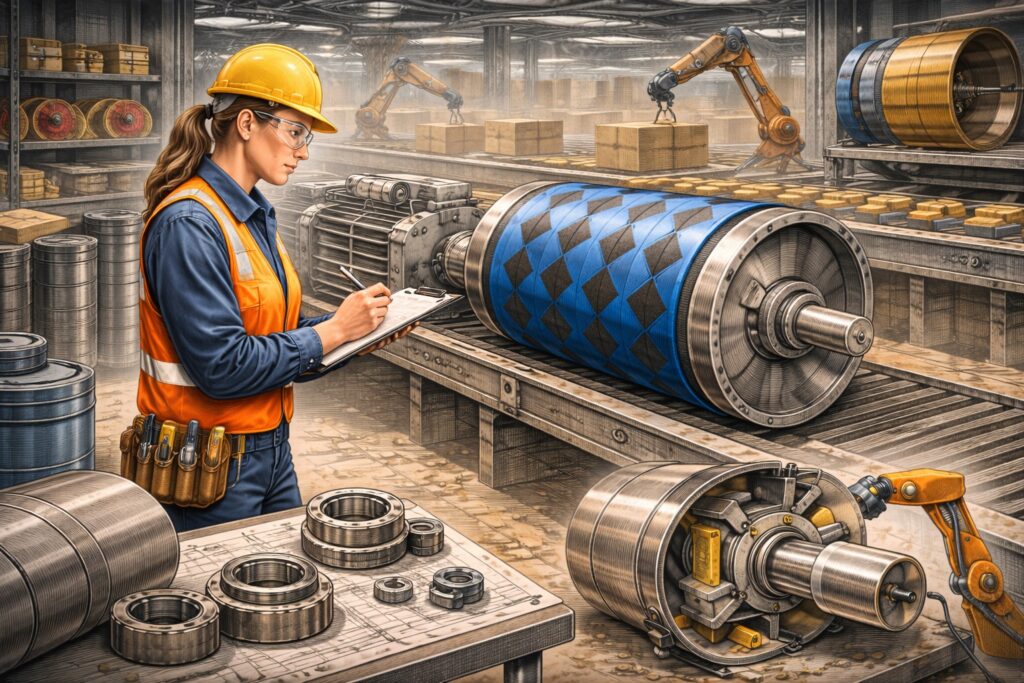

Unexpected conveyor failures rarely begin with the belt itself. Many issues originate from mismatched or poorly specified pulleys. A conveyor system may appear stable during installation, yet hidden stresses on pulleys can gradually cause performance issues.
For manufacturing plants and warehouse operations across the United States, conveyor reliability directly influences productivity and maintenance costs. Poor selection of pulleys without considering load conditions or belt requirements results in accelerated wear and frequent maintenance interruptions.
This is why operations teams frequently ask: Who are the top conveyor pulley suppliers? The answer often depends on how well suppliers support durability through engineering guidance, component selection, and long-term system compatibility.
Why Conveyor Durability Starts With Pulley Design
Conveyor pulleys serve as structural and mechanical anchors within a conveyor system. They guide belt motion, transfer rotational power, and help maintain belt tracking.
The durability of a conveyor system often begins with proper pulley specification.
Important factors include:
- Shell thickness that supports operational loads
- End disc strength to resist deformation
- Shaft diameter capable of handling torque and bending stress
- Lagging compatibility for traction and wear resistance
Pulleys with incorrect specifications may create uneven belt loading. Over time, this leads to belt drift, vibration, and accelerated component wear.
Proper specification allows the pulley to distribute forces evenly throughout the conveyor structure. This improves system stability and reduces the frequency of maintenance.
Material Selection and Its Impact on System Longevity
Material quality significantly affects pulley performance in demanding conveyor environments.
Important material considerations include:
- Steel grade selection for structural strength
- Corrosion resistance for humid or chemical environments
- Lagging material compatibility for friction control
- Surface treatment options to reduce wear
Industrial conveyor systems in manufacturing and distribution facilities across the United States often operate continuously. Under these conditions, lower-quality materials may deteriorate more quickly.
Reliable suppliers help match pulley materials to operating conditions. Proper material selection helps pulleys withstand repeated loading cycles, friction, and environmental exposure.
Precision Engineering and Component Compatibility
Even small deviations in pulley alignment or balance can influence conveyor performance. Precision engineering ensures pulleys operate smoothly within the conveyor structure.
Precision manufacturing processes typically include:
- Computer-controlled machining for accurate dimensions
- Balanced pulley assemblies to minimize vibration
- Consistent weld quality for structural integrity
- Tight tolerance control for shaft and hub fitment
When pulleys are out of balance or misaligned, belts may track unevenly. Increased friction and vibration can shorten component lifespan.
Suppliers that prioritize engineering accuracy help ensure conveyor pulleys operate consistently under industrial conditions.
Standard vs. Custom Pulley Solutions
Conveyor systems vary widely depending on industry requirements, belt design, and operational load conditions.
Standard pulleys often perform well in predictable material handling environments. However, complex systems may require custom specifications.
Situations where customized pulleys improve durability include:
- Heavy load transport
- High-speed conveyor lines
- Specialized belt materials
- Unique environmental conditions
Customization allows engineers to adjust pulley dimensions, shaft sizing, lagging materials, and mounting configurations.
At the same time, standardized pulleys remain effective for many applications where system loads and operating conditions are predictable.
Balancing customization and standardization allows facilities to maintain durability while controlling equipment costs.
The Supplier’s Role in Long-Term Conveyor Reliability
The role of a conveyor pulley supplier often extends beyond providing individual components. Suppliers frequently assist with specification guidance and long-term system planning.
Support may include:
- Identifying compatible pulley configurations
- Providing replacement component availability
- Offering inspection guidance for wear detection
- Supporting refurbishment or replacement planning
Facilities evaluating conveyor infrastructure often ask: Who are the top conveyor pulley suppliers?
In many cases, the answer depends on how well a supplier helps maintain system reliability over time. Reliable suppliers focus on compatibility, durability, and operational support rather than simply providing components.
Engineering Collaboration and System Performance
Durable conveyor systems often result from collaboration between equipment suppliers, system integrators, and engineering teams.
Engineering collaboration may involve:
- Load analysis for pulley sizing
- Belt compatibility evaluation
- Conveyor layout considerations
- Operational stress analysis
This collaborative approach ensures pulleys align with the broader conveyor system design while reducing the likelihood of system imbalance or premature wear.
Choosing Conveyor Pulley Suppliers That Support System Reliability
Conveyor durability depends on multiple technical factors, but pulley specifications remain among the most influential. Structural design, material quality, engineering accuracy, and proper system compatibility all contribute to long-term performance.
Suppliers that prioritize these elements help industrial operations maintain stable material handling systems with fewer disruptions.
Businesses evaluating conveyor equipment can contact Heinrich Brothers Inc. to review conveyor pulley solutions in Pennsylvania, United States.