
Artificial intelligence is triggering one of the largest digital infrastructure investment cycles in modern history. Global demand for GPU compute is expanding rapidly, and the infrastructure required to support this growth is becoming a major focus for institutional investors, infrastructure funds, and energy-backed asset managers.
However, traditional hyperscale data center development faces growing constraints. Grid interconnection delays, power availability issues, land limitations, and multi-year construction timelines are slowing down infrastructure deployment. As a result, investors are increasingly evaluating alternative models that can deploy capital faster and generate earlier revenue.
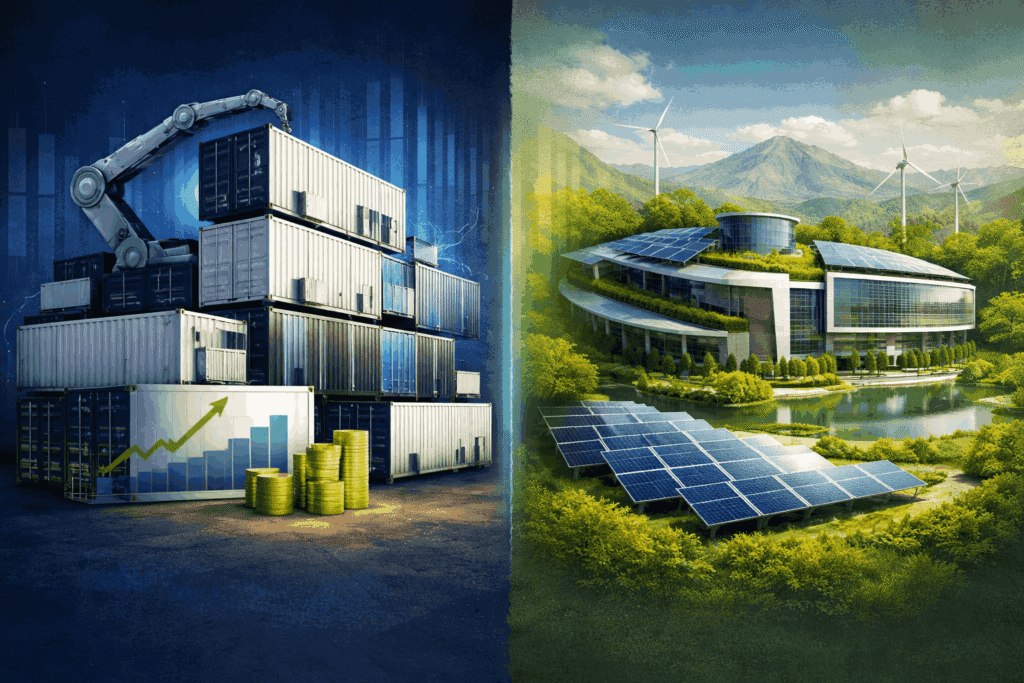
Two models are currently shaping the future of AI infrastructure investment: sustainable hyperscale data centers and modular renewable-integrated data centers.
While both approaches aim to support high-performance computing demand, they differ significantly in terms of capital deployment, risk management, time-to-revenue, and operating margins. For investors evaluating long-term digital infrastructure assets, understanding these differences is critical.
Below are eight key contrasts that infrastructure investors are increasingly analyzing when allocating capital to next-generation data center assets.
1. Sustainability Strategy vs Infrastructure Investment Model
Sustainable hyperscale data centers focus primarily on reducing environmental impact while maintaining high computing performance. Many large campuses integrate renewable energy sourcing, energy-efficient cooling technologies, and sustainability reporting frameworks.
However, in most cases renewable energy is procured through long-term power purchase agreements rather than being generated directly at the data center site. This approach improves sustainability metrics but does not necessarily change the underlying infrastructure structure.
Modular renewable data centers take a different approach by integrating energy generation directly with computing infrastructure. Solar generation, battery storage, and backup power systems are often deployed alongside modular compute units.
For investors, this integration creates a more predictable infrastructure model where energy supply and compute capacity are aligned, improving long-term operating stability and cost control.
2. Capital Deployment Efficiency
One of the most important factors for infrastructure investors is the efficiency of capital deployment.
Traditional hyperscale data center campuses typically require very large upfront investments. Land acquisition, transmission infrastructure, substations, cooling systems, and facility construction must be completed before meaningful compute capacity becomes operational. These projects often require billions of dollars in capital before reaching full capacity.
Modular data centers follow a phased infrastructure deployment model. Instead of building hundreds of megawatts at once, operators deploy smaller compute modules that can scale gradually as demand increases.
Each module typically supports between 400 kW and 1 MW of IT load, allowing infrastructure capacity to grow alongside market demand.
This phased approach offers several investment advantages:
- Lower initial capital exposure
• Faster asset activation
• Reduced risk of overbuilding infrastructure
• Capital deployment aligned with real demand growth
For investors seeking efficient capital allocation, modular infrastructure provides a more flexible investment structure.
3. Time-to-Revenue and Infrastructure Cash Flow
Infrastructure investment performance is heavily influenced by the speed at which assets begin generating revenue.
Hyperscale campuses often require five to eight years to move from site acquisition and permitting to full operational capacity. During this time, large amounts of capital remain tied up in development costs without producing income.
Modular data center deployments dramatically compress this timeline.
Factory-built compute modules can often be deployed within six to twelve months once power and site approvals are secured. This allows operators to begin generating revenue far earlier than traditional development cycles.
For investors, faster infrastructure deployment can significantly improve financial performance by:
- accelerating cash flow generation
• improving potential internal rate of return (IRR)
• reducing exposure to long development timelines
• enabling faster reinvestment of capital
In rapidly growing AI infrastructure markets, speed of deployment is becoming a major competitive advantage.
4. Energy Cost Stability and Infrastructure Margins
Energy represents the largest operating cost for most data center facilities.
Traditional hyperscale campuses rely heavily on grid interconnections, which expose operators to electricity price fluctuations, transmission bottlenecks, and regional energy market volatility.
Modular renewable-integrated data centers can operate through a behind-the-meter energy model where power generation is located directly at or near the compute infrastructure.
Solar generation combined with battery storage can provide a stable power supply while reducing reliance on grid electricity markets.
From an investment perspective, this structure can deliver:
- greater energy price stability
• improved long-term operating margin predictability
• access to renewable energy incentives and tax credits
• increased infrastructure resilience
Stable energy costs are particularly important for AI infrastructure where GPU clusters operate at very high power densities.
5. Infrastructure Risk Diversification
Traditional hyperscale campuses concentrate enormous amounts of capital into a single geographic location. While this approach can deliver large capacity, it also creates exposure to regional risks such as permitting delays, power shortages, regulatory changes, or construction challenges.
Modular infrastructure distributes capacity across multiple sites.
Each modular unit operates as an independent infrastructure asset capable of generating revenue. Additional units can be deployed in different locations based on power availability and demand growth.
For infrastructure investors, this distributed model improves portfolio risk management by providing:
- geographic diversification
• reduced exposure to single-site development risks
• flexible capital allocation across multiple markets
• the ability to respond quickly to emerging compute demand
This distributed approach aligns closely with portfolio strategies used by infrastructure investment funds.
6. ESG Performance and Institutional Investment
Environmental, social, and governance (ESG) considerations are becoming increasingly important in infrastructure investment decisions. Institutional investors are placing greater emphasis on carbon intensity, energy sourcing transparency, and sustainability reporting.
Large centralized data center campuses can place heavy power demand on regional electricity grids, sometimes requiring new transmission infrastructure to support expansion.
Modular renewable data centers distribute computing capacity across smaller sites while integrating renewable energy sources closer to the infrastructure.
This approach can improve ESG metrics by reducing transmission losses, lowering carbon intensity, and aligning energy generation directly with computing demand.
For investors seeking infrastructure assets that meet sustainability criteria, renewable-integrated modular deployments offer a compelling ESG profile.
7. Scalability for AI Infrastructure Demand
Artificial intelligence workloads are dramatically increasing power density requirements within data centers. Large GPU clusters require significantly more electricity and advanced cooling systems compared to traditional enterprise workloads.
Hyperscale campuses offer enormous scale but often face challenges expanding capacity quickly due to grid constraints and construction timelines.
Modular infrastructure provides greater deployment flexibility. New compute pods can be installed wherever power resources and demand intersect, enabling faster expansion across multiple markets simultaneously.
For investors, the ability to scale infrastructure quickly allows operators to capture demand during periods of rapid AI growth rather than waiting years for hyperscale projects to come online.
8. The Emerging AI Infrastructure Investment Model
The future of digital infrastructure will likely include a combination of large centralized campuses and distributed modular deployments.
Hyperscale facilities will remain essential for large cloud providers and centralized compute clusters. However, modular renewable-integrated data centers are emerging as a complementary model capable of accelerating infrastructure deployment.
Several macro trends are driving investor interest in this model:
- rapidly growing AI electricity demand
• increasing grid interconnection delays
• rising ESG reporting expectations
• investor preference for faster capital payback cycles
By integrating compute infrastructure directly with renewable energy systems, modular deployments align closely with these investment priorities.
Why Modular Renewable Data Centers Are Attracting Investor Capital
The comparison between hyperscale and modular deployments highlights a structural shift in digital infrastructure investment strategy.
While large campuses continue to dominate traditional cloud infrastructure, modular renewable data centers are increasingly viewed as a scalable asset class capable of supporting the rapid expansion of AI compute demand.
For investors, modular infrastructure offers several attractive characteristics:
- faster infrastructure deployment
• earlier revenue generation
• reduced dependence on grid power availability
• scalable capital deployment strategies
• improved energy cost predictability
These factors make modular renewable data centers an appealing opportunity for infrastructure funds, energy investors, and digital asset platforms seeking exposure to the rapidly growing AI economy.
Building the Next Generation of AI Infrastructure
Artificial intelligence adoption continues to expand across industries including finance, healthcare, manufacturing, research, and autonomous technologies. Supporting this growth requires infrastructure that can be deployed quickly while maintaining long-term energy reliability.
Flux Core Data Systems & Energy Inc. develops modular renewable-integrated micro-edge data centers designed to accelerate infrastructure deployment and improve capital efficiency.
For investors evaluating the next generation of digital infrastructure assets, modular renewable data centers represent a new model capable of delivering faster growth, scalable capital deployment, and attractive long-term returns.