
Material selection errors rarely show up on day one. They appear months later as premature wear, chemical stress cracking, warped components, or unexpected downtime. In industrial environments across Canada, choosing between low-density polyethylene and high-density polyethylene sheet is essential.
This decision directly affects durability, fabrication efficiency, and long-term operating costs. The difference matters because polyethylene grades may look similar, but their internal structures lead to very different performance outcomes.
Johnston Industrial Plastics Limited supplies and machines both low-density and high-density polyethylene for industrial applications. This helps businesses match material performance to operational demands with precision.
Understanding Polyethylene at a Structural Level
Both LDPE and HDPE belong to the polyethylene family. The key difference lies in molecular branching.
- Low-density polyethylene (LDPE) has a highly branched molecular structure.
- High-density polyethylene (HDPE) has a more linear, tightly packed molecular structure.
This structural variation affects density, crystallinity, and intermolecular bonding.
LDPE characteristics:
- Lower density
- Greater flexibility
- Softer feel
- Higher ductility
HDPE characteristics:
- Higher density
- Greater stiffness
- Higher tensile strength
- Improved structural rigidity
Because HDPE molecules pack more tightly, the material develops stronger intermolecular forces. This structural efficiency makes high-density polyethylene sheets stronger and more resistant to deformation under load.
Mechanical Performance Comparison
Mechanical performance often determines whether a component succeeds in industrial use.
- Tensile Strength and Rigidity
HDPE offers higher tensile strength compared to LDPE. It maintains dimensional stability under stress and handles structural loads more effectively. LDPE, while softer, absorbs impact well due to its flexibility. It bends rather than cracks under sudden force.
- Impact Resistance
Both materials offer strong impact resistance, but they behave differently:
- LDPE flexes and stretches.
- HDPE resists impact due to its stiffness and structural integrity.
In high-load applications such as tank liners, wear strips, or machined components, high-density polyethylene generally performs better.
- Wear and Abrasion
HDPE provides improved abrasion resistance. In material handling systems, this translates into a longer service life and fewer maintenance cycles. LDPE performs adequately under low stress but may deform under prolonged pressure.
Chemical and Environmental Resistance
Both LDPE and HDPE resist moisture and many chemicals. However, performance differences appear under demanding industrial conditions.
- Chemical Resistance
Both grades resist:
- Acids
- Alcohols
- Many solvents
- Moisture exposure
HDPE performs better under harsher chemicals and prolonged exposure. Its dense molecular structure limits permeation and stress cracking.
- UV and Weather Exposure
Neither LDPE nor HDPE inherently resists UV radiation without stabilization. Additives improve weather performance.
HDPE, when UV-stabilized, is widely used in outdoor applications such as:
- Storage tanks
- Outdoor signage backings
- Playground and infrastructure components
LDPE, being softer, is often chosen for flexible outdoor covers or protective sheeting.
- Temperature Performance
LDPE handles lower temperatures well due to its flexibility. It resists brittle fracture in cold environments. HDPE performs well across a broad temperature range but maintains greater dimensional stability under moderate heat.
Fabrication and Machining Differences
Material behaviour during fabrication significantly affects production efficiency.
- Machinability
High-density polyethylene machines cleanly. It produces smooth edges and maintains tolerances well. This makes it suitable for:
- CNC-machined components
- Bushings
- Wear pads
- Custom industrial parts
LDPE, due to its softness, can be more difficult to machine with tight tolerances. It may deform slightly under cutting pressure.
- Welding and Forming
LDPE offers excellent thermoforming properties. It bends and shapes easily without cracking. HDPE welds well using hot air or extrusion welding methods. It forms durable tanks, liners, and fabricated assemblies.
- Dimensional Stability
HDPE provides greater stability after machining. It holds shape better under mechanical stress. LDPE may exhibit slight creep under continuous load.
For industrial plastic machining and fabrication in Canada, HDPE sheet is often a preferable choice for structural components, while LDPE is used for flexible and cushioning applications.
Real-World Application Comparison
Understanding application context simplifies material selection.
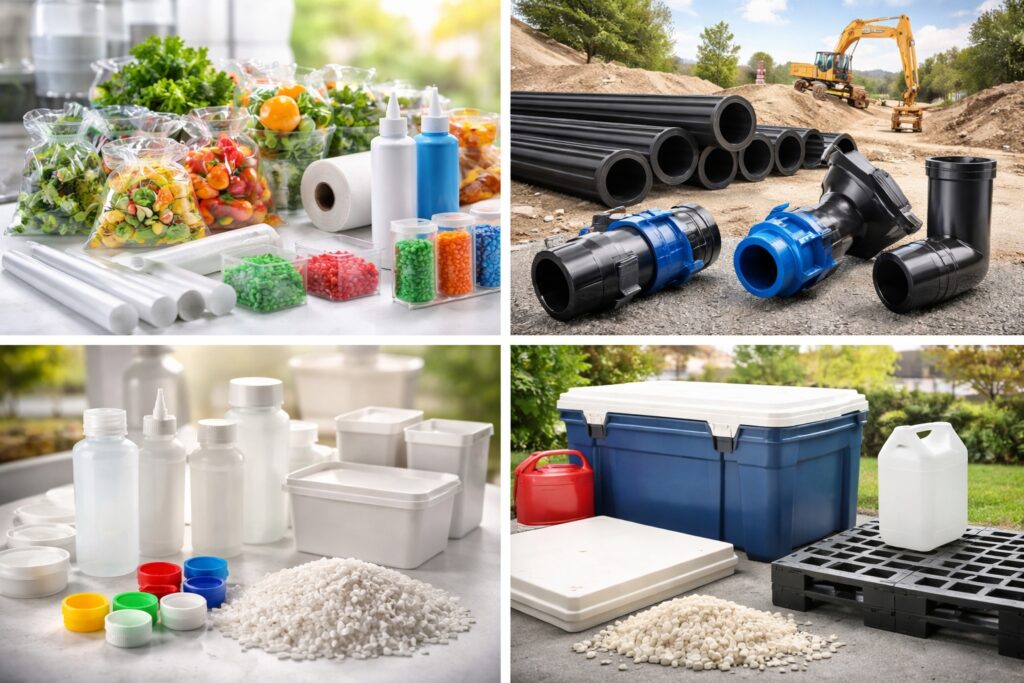
Common LDPE Applications
- Flexible liners
- Protective covers
- Packaging films
- Tubing
- Agricultural sheeting
LDPE excels where flexibility, impact absorption, and low rigidity are priorities.
Common HDPE Applications
- Industrial tanks
- Chemical storage containers
- Precision-machined industrial components
- Conveyor wear strips
- Cutting boards and food-grade surfaces
High-density polyethylene performs well in load-bearing, abrasion-prone, and structural roles.
Choosing Between LDPE and HDPE for Your Application
Several factors determine the correct polyethylene grade:
- Load Requirements: Structural or load-bearing parts favour HDPE.
- Flexibility Needs: Applications requiring bending or impact cushioning favour LDPE.
- Machining Precision: Tight tolerances favour high-density polyethylene.
- Environmental Exposure: Outdoor or chemically aggressive environments often favour stabilized HDPE.
- Budget Considerations: Both materials remain cost-effective compared to many engineering plastics. However, premature failure due to incorrect grade selection increases lifecycle costs.
In many Canadian industrial environments, high-density polyethylene provides a balanced combination of durability, strength, and machinability.
Why Material Selection Support Matters
LDPE and HDPE serve different purposes despite sharing a common base polymer. LDPE provides flexibility and impact absorption. HDPE delivers strength, machinability, and long-term structural reliability.
For businesses in Canada requiring plastic machining and fabrication, material selection directly influences performance and cost efficiency.
Selecting the wrong grade can lead to:
- Warping
- Stress cracking
- Tolerance drift
- Increased downtime
- Higher maintenance costs
Johnston Industrial Plastics Limited works with businesses across Canada to supply and machine high-density polyethylene for industrial fabrication projects. Proper material selection support ensures components perform as expected in real-world conditions.
Contact Johnston Industrial Plastics Limited to discuss HDPE sheets in Canada for industrial applications, and to request guidance on materials and fabrication support.