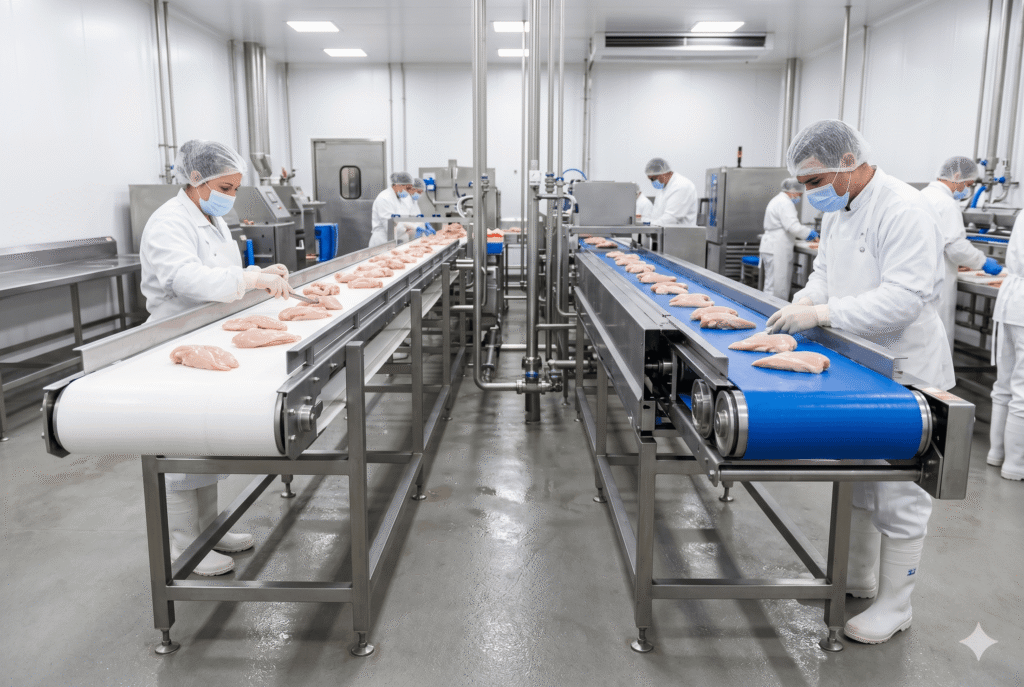

Selecting between a flat belt conveyor and a retractable conveyor is a critical decision in food processing environments where sanitation, throughput consistency, and long-term operating efficiency must align. Both Belt conveyors serve different operational roles, and the appropriate selection depends on product characteristics, facility layout, and processing conditions.
Sanitary Design Considerations for Flat Belt Conveyors
Monolithic Thermoplastic Versus Modular Surfaces
A flat belt conveyor often uses a monolithic thermoplastic belt that provides a continuous, non-porous surface. This reduces areas where residue can accumulate and supports more efficient cleaning cycles. Compared to modular designs, this configuration simplifies sanitation in high-risk environments.
Surface Geometry and Allergen Control
A flat belt conveyor with simplified structural geometry reduces liquid pooling and residue retention. Tool-less disassembly further supports faster cleaning and improved allergen control in regulated environments.
Production Flow Capabilities of Retractable Conveyors
Dynamic Product Routing and Transfer
A retractable conveyor supports flexible product routing across multiple lanes or deposit points. This capability allows consistent distribution without manual handling, making it suitable for operations with complex layouts.
Space Optimization and Layout Flexibility
A retractable conveyor enables compact installation by supporting tighter turning radii and adaptable positioning. This allows better use of available floor space in constrained environments.
Maintenance and Cost Considerations
Lifecycle Performance and Replacement Requirements
A flat belt conveyor typically involves fewer moving components, which supports simplified maintenance and longer replacement intervals in wet environments. In contrast, a retractable conveyor includes additional mechanical elements that require more frequent inspection.
Reducing Downtime Through Design Stability
Stable belt tracking in a flat belt conveyor supports consistent throughput and reduces slippage risks. A retractable conveyor, while flexible, requires maintenance strategies that account for movement cycles.
Automation Integration and Operational Scalability
Compatibility with Control Architectures
A flat belt conveyor integrates more easily with automation frameworks due to simpler motion profiles. A retractable conveyor may require additional control coordination for movement synchronization.
Supporting Complex Processing Requirements
Belt conveyors are widely used for continuous flow and sorting applications. A flat belt conveyor supports stability across long production runs, while a retractable conveyor adds flexibility at transfer points.
Decision Considerations for Food Processing Applications
Selecting between a flat belt conveyor and a retractable conveyor depends on operational priorities:
- A flat belt conveyor supports sanitation-focused environments
- A retractable conveyor supports routing flexibility
- Maintenance requirements vary based on mechanical complexity
- Layout constraints influence equipment selection
Conclusion
A flat belt conveyor and a retractable conveyor each address specific operational needs within food processing environments. Belt conveyors must be selected based on sanitation requirements, layout complexity, and production flow demands to ensure consistent performance.
For operations evaluating equipment selection and long-term performance, Conovey provides engineering support to align conveyor design with processing requirements. Connect with Conovey to assess operational conditions and implement material handling solutions that support hygiene, efficiency, and reliable production outcomes.