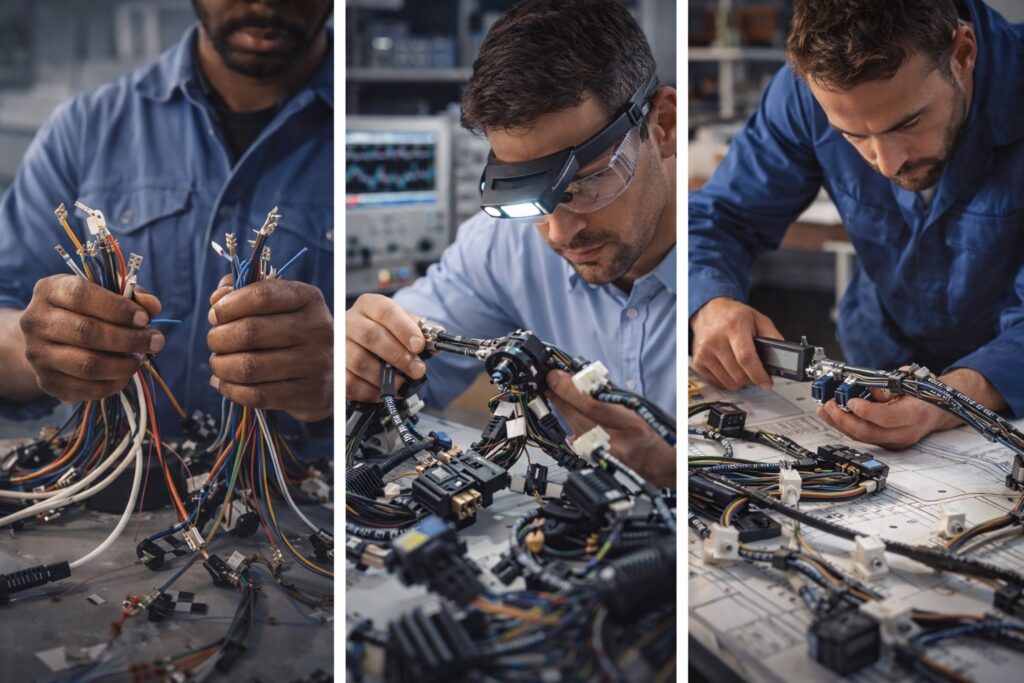

A single wiring fault can shut down an assembly line, delay a product launch, or trigger compliance failures in regulated markets. In most industries, mistakes made by wire harness manufacturers carry real financial and operational consequences.
Engineers often face pressure to shorten timelines while increasing product complexity. When cable and wire harness systems must integrate with printed circuit board assemblies (PCBAs), coordination gaps can be costly. Star Engineering Inc. provides customized printed circuit board assembly (PCBA) services and integrated cable and wire harness assemblies that align engineering intent with production requirements.
Below are three critical challenges in wire harness manufacturing that engineers should prepare for.
Challenge 1: Design-to-Manufacturing Gaps
Design teams focus on electrical performance. Manufacturing teams focus on repeatability and assembly efficiency. When those priorities are not aligned early, problems surface during production.
Common design-to-manufacturing gaps include:
- Tight bend radii that complicate multi-conductor cable assemblies
- Inadequate labeling for IDC flat ribbon cable assemblies
- Connector selections that increase manual rework
- Limited routing space for RF coaxial cable assemblies, which complicates proper shielding.
- Overlooked strain relief in battery cable assembly manufacturers in the USA requirements
These gaps often arise when harness designs are integrated with control panels and electromechanical assemblies in the USA.
Early review of wire harness applications alongside PCBA layouts reduces revision cycles. Coordinated engineering services and supply chain management also help standardize components before procurement begins.
Challenge 2: Quality Control in High-Complexity Assemblies
As systems grow more advanced, the number of interconnections increases. Aerospace and defense, medical cable assembly projects, and military assemblies require strict traceability and documentation.
Quality risks include:
- Improper crimping in wire jumper assemblies
- Shielding inconsistencies in RF coaxial cable assemblies
- Crossed conductors during custom cable assembly builds.
- Insufficient inspection of solder joints during PCBAs integration
High-complexity harnesses often connect directly to boards built with SMT surface-mount technology and through-hole PCB assembly technology. Any mismatch between harness tolerances and board layout can cause signal instability or mechanical stress.
Strong quality control processes that wire harness manufacturers follow include:
- Continuity and functional testing
- IPC-compliant inspection standards
- Clear documentation for aerospace and medical environments
- Lot traceability within supply chain management systems
When quality planning begins at the design stage, downstream risk decreases significantly.
Challenge 3: Scaling From Prototype to Production
A harness that functions in a prototype may not scale efficiently. Engineers often validate performance in low volumes. Production teams must then reproduce that performance consistently across higher quantities.
Scaling challenges include:
- Manual steps that slow multi-conductor cable assemblies
- Limited sourcing options for specialized connectors
- Inconsistent lead times that affect the custom cable assembly manufacturers’ schedules
- Variations in harness routing within box build assembly operations in the USA.
In industries such as consumer electronics and industrial automation, production ramp speed directly affects market entry. For the automotive industry and aerospace and defense programs, delays impact compliance milestones.
Designing for manufacturability from the start helps prevent bottlenecks. Aligning wire harness assembly layouts with electro-mechanical assemblies streamlines scaling.
How Early Collaboration Reduces Risk
Early coordination between engineering and cable and wire harness specialists closes critical gaps.
Benefits include:
- Improved component standardization
- Reduced redesign cycles
- Clear integration between the printed circuit board assembly and the harness routing
- Better forecasting through supply chain management planning
- Faster transition from prototype to production
When the workflows for harness design, SMT (surface-mount technology) integration, and box-build assembly are aligned, performance becomes more predictable.
Practical Checklist for Engineers
Wire harness manufacturing plays a central role in modern electronics systems. Design-to-manufacturing gaps, quality control challenges, and scaling risks can disrupt performance across the consumer electronics, automotive, aerospace and defense, and medical devices sectors.
Before releasing a harness design, confirm the following:
- Bend radius and strain relief meet application requirements
- Connector types match both PCBA and control panels
- Shielding and grounding support the RF coaxial cable assemblies’ needs
- Test plans include continuity and functional verification
- Documentation meets military assemblies or medical device standards where required
- Component availability aligns with supply chain management forecasts
- Prototype builds consider scaling to full production volumes
Addressing these factors early improves reliability and reduces downstream risk across wire harness applications.
Careful planning and early collaboration with an experienced wire harness supplier help reduce these risks. For tailored cable and wire harness solutions aligned with circuit board customization needs, connect with Star Engineering Inc.